Paying points can make sense if you keep the loan long enough for monthly savings to recover the upfront cost. Shawn starts with how long you expect to own the home—and whether you may refinance first.
First, the math on Shawn’s pad.
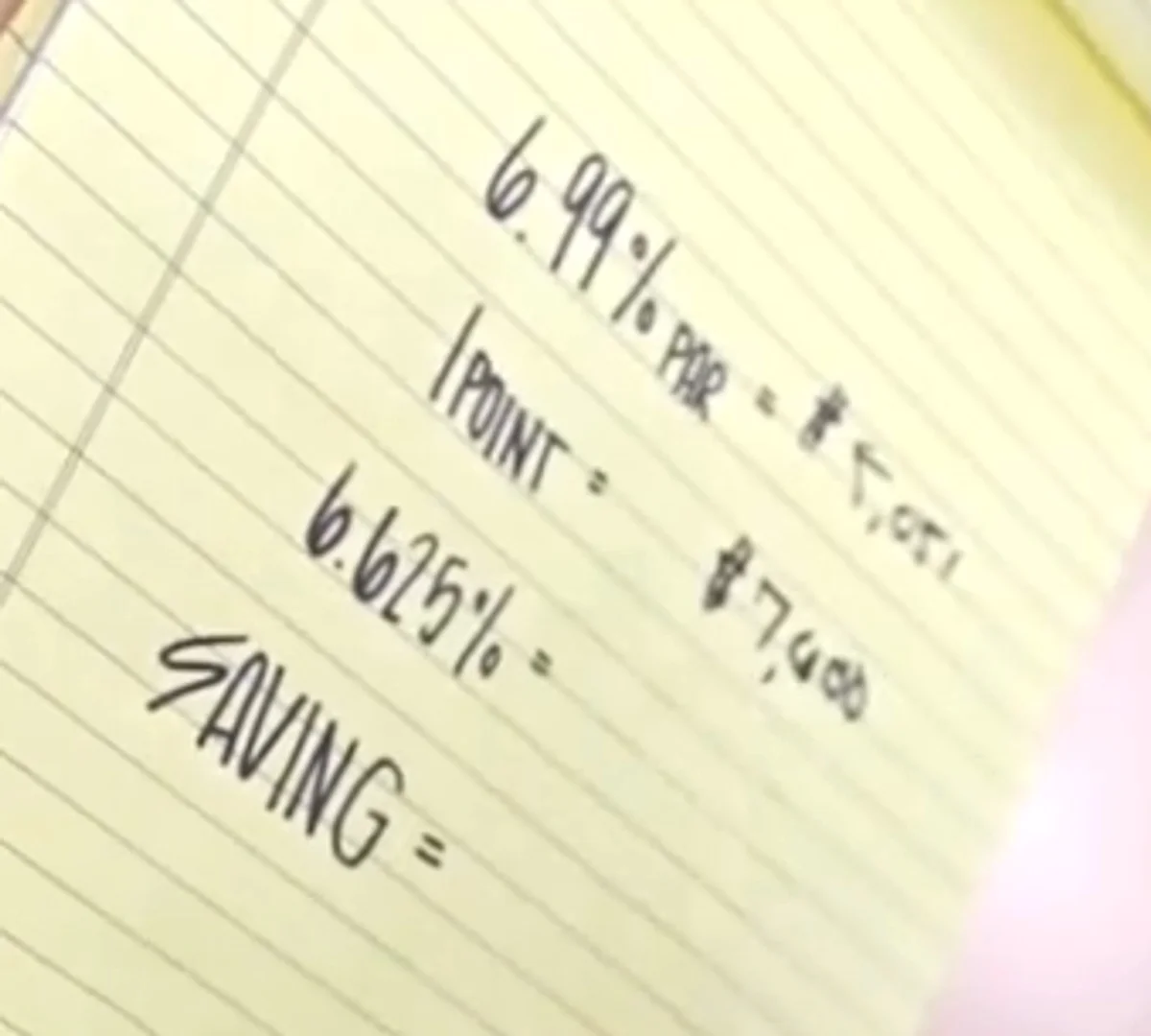
Shawn starts with a $950,000 purchase, 20% down and a $760,000 loan. One discount point is 1% of the loan amount: $7,600. His historical 30-year example compares these two choices.
Shawn’s historical example · rounded monthly principal and interest
Structure
Rate
Payment
No discount point
6.99%
$5,051
Pay one point
6.625%
$4,866
Historical educational example only. Rates, payments and costs shown are not current pricing or an offer. Principal and interest only; taxes, insurance and any applicable mortgage insurance are additional. One point does not buy the same rate reduction in every loan.
The actual notes from Shawn’s video.
When do the savings catch up?
$7,600 ÷ $185 ≈ 41.1 months
Using Shawn’s rounded payment figures, the upfront cost is recovered during the 42nd monthly payment—about three and a half years.
That is a simple cash-flow break-even. It does not account for investment returns on the upfront cash, taxes, differences in loan balances or a refinance. It is a starting comparison, not the full decision.
Then, his two questions.
01
How long do you plan on owning this home?
If the likely holding period is short, there may not be enough time to recover the points. Even a long stay in the home does not guarantee you will keep the same loan.
02
What do you think happens to rates?
Shawn asks this because a refinance could shorten the life of today’s loan. Future rates and the ability to refinance are uncertain. Compare the outcome if rates fall—and if they do not.
Watch both parts.
The first explains the numbers. The second explains why the numbers alone do not settle the decision.
The first clip’s $66,000 headline assumes keeping the loan for all 30 years and is before the cost of the point. See the full calculation below.
Part one: Shawn works out the points example. Video with captions. Read the transcript below.Read the transcript
Let's say you're going to buy a house for $950,000 and you're going to put 20% down. So that'd be $190,000 down payment with a loan amount of $760,000. Now in that scenario, let's just say your par rate is 6.99%. par rate meaning you're not paying any extra interest upfront. Your payment would be $5,051 in that scenario. Now what some people don't realize is just because the par rate is 6.99% doesn't mean you can't actually get a lower interest rate. You can actually buy the rate down and you could pay points. A point is a percent of the loan amount. So in this scenario, one point would be $7,600 and if you paid that prepaid interest upfront, you would actually get a rate of 6.625 instead of 6.99, which would give you a monthly payment of $4,866. So that's going to save you $185 a month. Now with that $185 a month savings, this is a 30-year loan keep in mind, so that actually saves you $66,000 in interest over the life of the loan. So essentially you're paying $7,600 one time upfront to save yourself $66,000 in interest. That's a nine times return on investment. Now that might sound like a really good idea. Stay tuned for the next video where I explain why I personally wouldn't recommend doing that.
Part two: the holding period and lender-credit comparison. Video with captions. Read the transcript below.Read the transcript
So in my last video I explained how you can save money by buying points, however it's not always the smartest thing to do depending on the scenario. One thing you have to consider is your breakeven point. How many months or years is it going to take you to make that money back? So when somebody asks me if they should buy points I always ask them these two questions. How long do you plan on owning this home? If you're not planning on owning this home for very long then no, absolutely do not buy any points. However if you're planning on keeping this home long term then maybe it might make sense to buy points. Question number two is what do you think is going to happen to rates in the future? If you think rates are going to go down in the future then don't buy points. Why would you pay extra cost up front for a lower rate that you're more than likely going to be able to get for zero points in the future? If you're going to keep the home long term and if you think rates are going to go down then do the opposite. Take an even higher interest rate. Just like buying points down you pay extra cost up front to get the lower interest rate, if you take an above par rate, a higher interest rate, you can actually get the bank to give you money back and you can use those credits, we call them rebate or discount points, you can use those to cover your other costs, even your taxes and insurance. So that's how you can get the bank to cover your taxes and your insurance on your purchase. If you have any questions about this or want me to run the scenario for you for your specific scenario, send me a message, let's talk.
What about the “$66,000”?
The clip rounds the full-term payment reduction to $66,000. Using the displayed $185 monthly difference gives $66,600 over 360 payments, before subtracting the $7,600 point cost. That leaves $59,000 in simple net payment savings if the loan is held for all 30 years and the comparison otherwise stays unchanged.
The video’s “nine times return” wording is not an annualized investment return. Selling or refinancing early changes the result. The transcript preserves what Shawn said; the calculation above makes the assumptions explicit.
The inverse: lender credits.
Instead of paying upfront for a lower rate, a borrower may compare a higher rate with a lender credit toward eligible closing costs. The tradeoff is less cash at closing against a higher ongoing payment. The credit is not free money, and its permitted uses depend on the transaction.
Ask Shawn to compare points, no points and lender credits on the same loan and time horizon.
Program mechanics reference: CFPB: lender credits and points. Page adapted from Shawn’s supplied two-part teaching; not a current loan offer.